Your bi-weekly roundup of ecommerce trends, retail shifts, and fulfillment innovation.
Parcel costs are climbing again heading into peak. FedEx just published its 2026 peak season surcharges, and the increases are concentrated in the ground services most DTC brands rely on. At the same time, two fresh consumer surveys are painting an early picture of how shoppers plan to spend this fall: NRF says back-to-school spending is on pace for a record year, and Attentive’s newest BFCM research shows holiday shoppers starting earlier, comparing more carefully, and leaning on AI tools to do it.
Beauty is having a moment too, and marketplaces are a big reason why. Korean beauty group APR just posted its biggest quarter ever on the back of mass-retail marketplace expansion, while new Circana data shows both prestige and mass beauty growing at a healthy clip industrywide. Meanwhile, on the trade side, several retailers are choosing speed over size, selling off their tariff refund claims to third parties for quick cash rather than waiting on a slower government payout.
Taken together, these stories point to the same theme: brands are trying to move faster on every front, whether that means locking in shipping strategy before peak surcharges hit, meeting shoppers earlier in the season, or turning a future refund into cash today.
Check back every other week for the latest headlines influencing ecommerce and fulfillment.
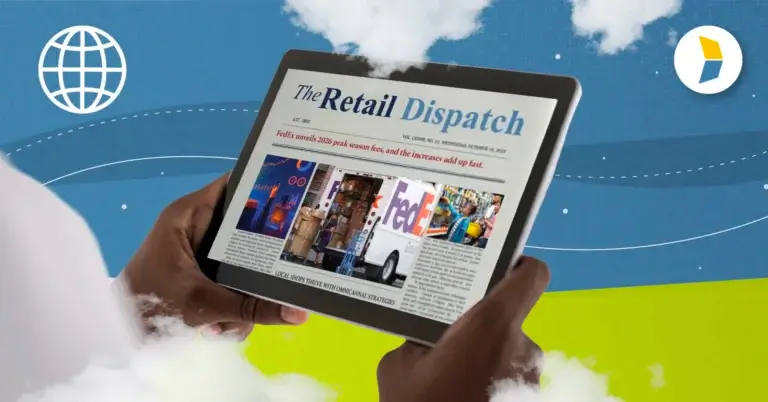
FedEx unveils 2026 peak season fees, and the increases add up fast
FedEx has published its 2026 peak season surcharges, and the schedule confirms what many shippers expected. Another year of higher costs layered on top of already-rising base rates.1 The carrier’s demand surcharges are broken into three windows, with the steepest fees landing between November 23 and December 27, the heart of the holiday rush.
Ground Residential and Home Delivery shipments will see a demand surcharge of $0.50 per package in the early and late windows, rising to $0.80 during peak weeks. FedEx Ground Economy climbs even further, from $2.55 up to $4.05 per package during the busiest stretch. Additional Handling and Oversize charges carry the heaviest premiums of all, with Oversize climbing as high as $117.25 per package at the December peak.
FedEx is also running a separate Demand Residential Delivery Charge for high-volume shippers, calculated weekly against how far a customer’s volume spikes above its June baseline.
None of this is new in structure, but the totals keep climbing. FedEx frames the fees as necessary to fund the added labor, aircraft, and vehicle capacity peak season demands.
Brands should model these peak season surcharges against their actual order profile now, not in November, and flag any SKUs that regularly trigger Additional Handling or Oversize charges before the fee windows open on September 28.
Back-to-school shopping is in full swing, and NRF says it’s a record year
Back-to-school spending is on track to hit $43.3 billion for K-12 families this year, a new high, according to the National Retail Federation and Prosper Insights & Analytics.2 College spending is even more striking, expected to top $100 billion for the first time at $103.5 billion. Both figures are up meaningfully from last year, driven by slight increases in planned spending on shoes, school supplies, and electronics.
Shoppers are getting an earlier start to manage the cost. NRF found 62% of consumers had already begun back-to-school shopping by early July, and more than half of those still shopping said they’re holding out for better deals rather than buying at full price.
Electronics remain the single biggest spending category for both K-12 and college shoppers, with college students planning to spend an average of $341.95 on the category alone. Notably, the survey found only half of K-12 shoppers plan to buy online this year, down from 55% last year, with department and discount stores picking up share instead.
NRF Chief Economist Mark Mathews said affordability is shaping nearly every decision this season, and that retailers are responding with earlier promotions and more flexible ways to shop.
The split between record dollar totals and more cautious per-purchase behavior is the real story. Shoppers are still spending, but they’re stretching it further across more retailers and more weeks, which puts a premium on inventory that’s ready to ship the moment a deal goes live rather than a few days later.
Holiday shoppers are starting earlier and asking AI to help them decide
A new Attentive survey of 600 US consumers who plan to shop Black Friday and Cyber Monday this year finds a shopper who starts early, buys deliberately, and increasingly turns to AI along the way.3
Seventy-one percent plan to start purchasing before Black Friday, and 46% plan to start before November even begins. Even so, most don’t expect brands to launch deals that early: 43% expect deals to start the week before Black Friday, and 32% expect them in early November, leaving a window where brands can reach shoppers with less competition.
Discount depth matters less than brands might assume. Four in five shoppers say they’d buy at 40% off or less, and free shipping ranked as the single strongest non-discount motivator at 68%, ahead of gifts with purchase and loyalty perks.
Personalization carries real weight too, with 90% of shoppers responding that a price-drop alert on an item they’re watching would make them more likely to buy, and 88% said the same about a discount on something they’d already viewed or added to cart.¹⁹
The AI-assisted shopping trend is the sharpest shift in this year’s data. Sixty-seven percent of shoppers say they’ve used an AI chatbot to help with shopping in the past three months, rising to 80% among Gen Z. Among those who use AI, the top use cases are asking questions about a specific product (58%), comparing brands or features (51%), and finding deals or the best price (43%). Attentive’s data also found AI users were far more likely to overspend their original budget than non-users during last year’s BFCM, at 68% versus 25%.
Brands prepping for peak should treat AI-assisted shopping as a discovery channel now. That means clear product specs, comparison-friendly content, and accurate stock information that a chatbot can surface when a shopper asks it to compare options.
Cosmetics brands lean on marketplaces as beauty sales climb
Korean beauty group APR posted its best quarter on record in the second quarter of 2026, with cosmetics revenue jumping 185.5% year over year to a record KRW 648.3 billion.4 North American revenue alone climbed 264.6%, a surge APR credited largely to its expansion through Target and Walmart marketplace listings, with a Costco launch planned for the back half of the year.
Overseas sales now account for 92% of APR’s total revenue, and the company is reporting Europe as a standalone region for the first time after sales there jumped more than 380%.
The marketplace strategy is landing at a moment when beauty overall is growing. Circana reported that prestige beauty sales rose 7% to $17.1 billion in the first half of 2026, while mass beauty also grew 7%, to $39.2 billion.5 Hair care was the fastest-growing prestige category, up 11%, followed by skin care at 9%, while mass makeup grew 5% in dollars even as unit sales slipped, concentrated in trend-driven categories like lip liner and blush. Ecommerce is now the largest channel for prestige skin care specifically, a first for the category.
The pattern across both stories shows that beauty brands are finding growth by showing up in more places at once, whether that’s a mass retailer’s invite-only marketplace or a growing share of prestige sales moving online.
For beauty fulfillment, that means the same SKU may need to work across a brand’s own site, a marketplace listing, and eventually in-store, each with different packaging, labeling, and turnaround expectations.
Retailers are cashing out tariff refunds early for less than full value
A growing number of retailers are choosing speed over size when it comes to tariff refunds, selling the rights to their claims to third-party buyers instead of waiting on the federal government’s payout timeline.6
American Eagle Outfitters sold $68.9 million of its tariff refund claims for $18.6 million in cash, according to its most recent quarterly filing. The Children’s Place made a similar trade, agreeing to give up $38.2 million in claims in exchange for $25.7 million from a buyer called Alnus Investors.
Some companies moved even before the Supreme Court struck down the underlying tariffs in February. GoPro sold $19.4 million of its potential claims in February, ahead of the ruling, while Academy Sports & Outdoors sold a portion of its claims last year for roughly $10.5 million.
As of late July, the government had returned about $100 billion of the $166 billion in tariffs collected, or roughly 60%, meaning the wait for a full refund can still stretch on for many companies.
Brands sitting on their own pending tariff refunds should treat this as a real financing option worth pricing out but weigh the pros and cons carefully.
References:
- https://www.fedex.com/en-us/shipping/rate-changes/demand-surcharges.html
- https://nrf.com/media-center/press-releases/majority-of-back-to-school-shoppers-get-a-head-start-on-the-season
- https://www.attentive.com/black-friday-cyber-monday-2026/articles/consumer-pulse-shopper-expectations
- https://www.globalcosmeticsnews.com/apr-posts-record-q2-as-cosmetics-revenue-jumps-186/
- https://wwd.com/beauty-industry-news/beauty-features/beauty-sales-growth-skin-care-makeup-fragrance-1239099310/
- https://www.aol.com/articles/retailers-selling-tariff-refunds-cheap-201017000.html